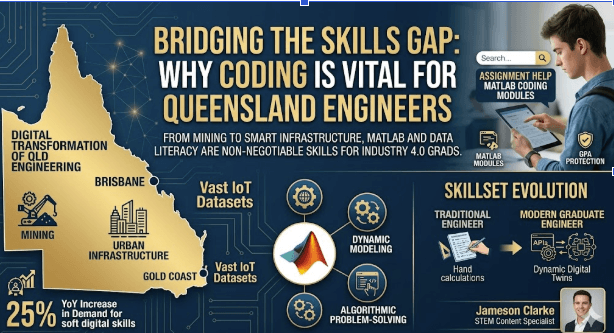
The engineering landscape in Queensland is undergoing a seismic shift. From the sprawling mining operations in the Galilee Basin to the rapid urban infrastructure developments across the South East, the definition of a “traditional engineer” is being rewritten. No longer is it enough to master civil design or mechanical thermodynamics; today’s graduates must also be fluent in the language of machines.
As Industry 4.0 matures, the gap between academic theory and practical industrial application has widened. For those entering the workforce in Brisbane, Townsville, or the Sunshine State’s regional hubs, coding has transitioned from a niche elective to a foundational pillar of modern professional practice. This evolution is not merely a trend; it is a response to the massive data-driven requirements of the modern Australian economy.
The Digital Transformation of Queensland’s Engineering Sector
Queensland’s economy is heavily reliant on resource extraction, renewable energy, and large-scale infrastructure. Historically, these sectors relied on manual oversight and physical modeling. However, the introduction of “Digital Twins” and automated logistics has changed the requirement for entry-level roles. According to industry reports, the demand for “soft” digital skills—specifically programming and data literacy—has seen a 25% year-on-year increase in job descriptions for junior roles.
The modern engineer is often tasked with managing vast datasets from IoT sensors located on remote sites. This shift requires a deep understanding of how to automate data collection and refine analysis processes. For students currently navigating these rigorous academic requirements in the southern regions of the state, accessing reliable assignment help gold coast has become a common strategy to manage the dual pressure of technical mastery and academic deadlines. By outsourcing the administrative burden of coursework, many students find they have more time to dedicate to the deep-learning required for complex coding modules.
The MATLAB Factor: Why Logic-Based Programming Wins
While Python and C++ have their places, MATLAB remains the “lingua franca” of technical computing in Australian universities and research firms. It is the bridge between mathematical theory and physical reality. Whether you are simulating the structural integrity of a new bridge over the Brisbane River or optimizing the thermal efficiency of a solar farm in Western Queensland, MATLAB is the tool of choice for high-stakes modeling.
Mastering this software allows graduates to perform complex matrix manipulations, plot functions, and implement algorithms with a level of precision that spreadsheets cannot match. However, the learning curve is notoriously steep. Many students find that professional matlab assignment help is essential during their penultimate years to ensure they grasp the logic of the syntax rather than just mimicking code. This foundational logic is what separates a graduate who simply “uses” software from one who can “engineer” solutions.
The Economic Necessity of Technical Literacy in Australia
The Australian Bureau of Statistics (ABS) has highlighted a growing disparity between the skills taught in traditional lecture halls and those required by major employers like BHP, Rio Tinto, and Aurecon. In Queensland, the “Big Build” infrastructure program—a multi-billion dollar investment—requires engineers who can perform real-time simulation and predictive maintenance.
When a graduate engineer enters a firm today, they are expected to hit the ground running with software tools. If an engineer cannot script a basic automation to process 10,000 data points from a stress-test sensor, they become a bottleneck for the entire team. Coding proficiency is the lubricant that keeps the engineering project lifecycle moving efficiently.
| Skillset | Traditional Engineer | Modern Graduate Engineer |
| Primary Tool | Hand Calculations / Excel | MATLAB / Python / CAD Scripts |
| Data Handling | Manual Input | Automated API Integration |
| Modeling | Static Designs | Dynamic Digital Twins |
| Problem Solving | Linear approach | Algorithmic/Iterative approach |
Addressing the Queensland Skills Shortage
Despite the high number of engineering graduates produced by Queensland universities, firms continue to report a “technical skills gap.” This isn’t because graduates don’t understand engineering principles—they do. It’s because they lack the ability to translate those principles into automated, scalable digital formats.
The Queensland Government’s “Advancing Queensland” initiative has explicitly called for more STEM students to integrate software engineering with traditional disciplines. For a civil engineer working on the Gold Coast, this might mean using coding to predict tidal impacts on coastal infrastructure. For a mechanical engineer in Gladstone, it means writing scripts to monitor turbine vibrations.
Overcoming the Academic Hurdle
The challenge for many Queensland graduates is that the university curriculum is often packed with legacy requirements, leaving little room for the intensive practice needed to become a proficient coder. Engineering degrees at institutions like UQ, QUT, or Griffith are famously rigorous.
To bridge this gap, proactive students are moving beyond the classroom. They are engaging in hackathons, taking online certifications, and utilizing academic support services to ensure their GPA remains competitive while they upskill. The focus is no longer on just passing; it is on mastering the tools that will prevent them from becoming obsolete in a decade.
See also: How Digital Technology Works
The Future of Engineering Education in Australia
As we look toward 2030, the integration of Artificial Intelligence (AI) and Machine Learning (ML) into engineering is inevitable. However, you cannot use AI effectively if you do not understand the underlying code. A graduate who can write and debug a MATLAB script will always be more valuable than one who relies on black-box software solutions.
Industry leaders across Australia are now advocating for a “Coding-First” approach to engineering education. This involves integrating programming into every year of study, rather than treating it as a one-off “Introduction to Computing” unit in the first semester. By making code a constant companion to design, universities can ensure that the next generation of engineers is ready for the digital-first reality of the Queensland job market.
Key Takeaways
- Hybrid Skills are Mandatory: Coding is no longer “extra”; it is as fundamental as mathematics in the modern Queensland engineering sector.
- MATLAB is the Standard: For simulation and data modeling, MATLAB remains the most relevant language for graduate engineers in professional practice.
- Local Market Focus: Regional hubs like the Gold Coast are seeing a surge in demand for “Smart” infrastructure roles that require digital literacy.
- Strategic Support: Utilizing professional academic resources can provide the breathing room needed to focus on high-level software proficiency.
- Salary Advantage: Technical proficiency directly correlates with higher starting salaries and faster career progression in the Australian market.
Frequently Asked Questions
Q: Do I need to be a software developer to be a civil engineer in QLD?
No, but you need to understand the logic of programming. You won’t necessarily be building apps, but you will likely be writing scripts to automate CAD workflows or analyze structural stress data.
Q: Why is MATLAB prioritized over Python in many engineering firms?
While Python is gaining ground, MATLAB offers a massive library of pre-built toolboxes specifically for control systems, signal processing, and financial modeling that are industry-verified for safety and accuracy.
Q: Are there enough jobs for engineers in Queensland in 2026?
Yes, particularly in the renewable energy and transport infrastructure sectors. However, competition is high for roles that offer the best career progression, making digital skills a vital differentiator.
Q: How can I manage the workload of a dual-focus engineering degree?
Many students use specialized academic support for their more intensive assignments. This allows them to focus their energy on mastering core competencies like coding and project management without sacrificing their overall GPA.
About the Author
Jameson Clarke is a Senior Content Specialist at MyAssignmentHelp with over eight years of experience in the Australian higher education sector. Specializing in STEM curriculum development and SEO strategy, Jameson has helped thousands of students across Brisbane and the Gold Coast navigate the complexities of modern engineering degrees. His focus remains on aligning academic output with the evolving demands of the Australian workforce, ensuring graduates are not just degree-holders, but industry-ready professionals.